
The three parts of a flow
| Part | Question it answers | Example |
|---|---|---|
| Trigger | When should this start? | Someone types !hello |
| Condition | Should it continue? | The viewer is a moderator |
| Action | What should happen? | Send a chat message |
A straight line of nodes can use the Simple form. Switch to Canvas when you need branches, extra checks or loops. Both views edit the same flow.
Open and read the canvas
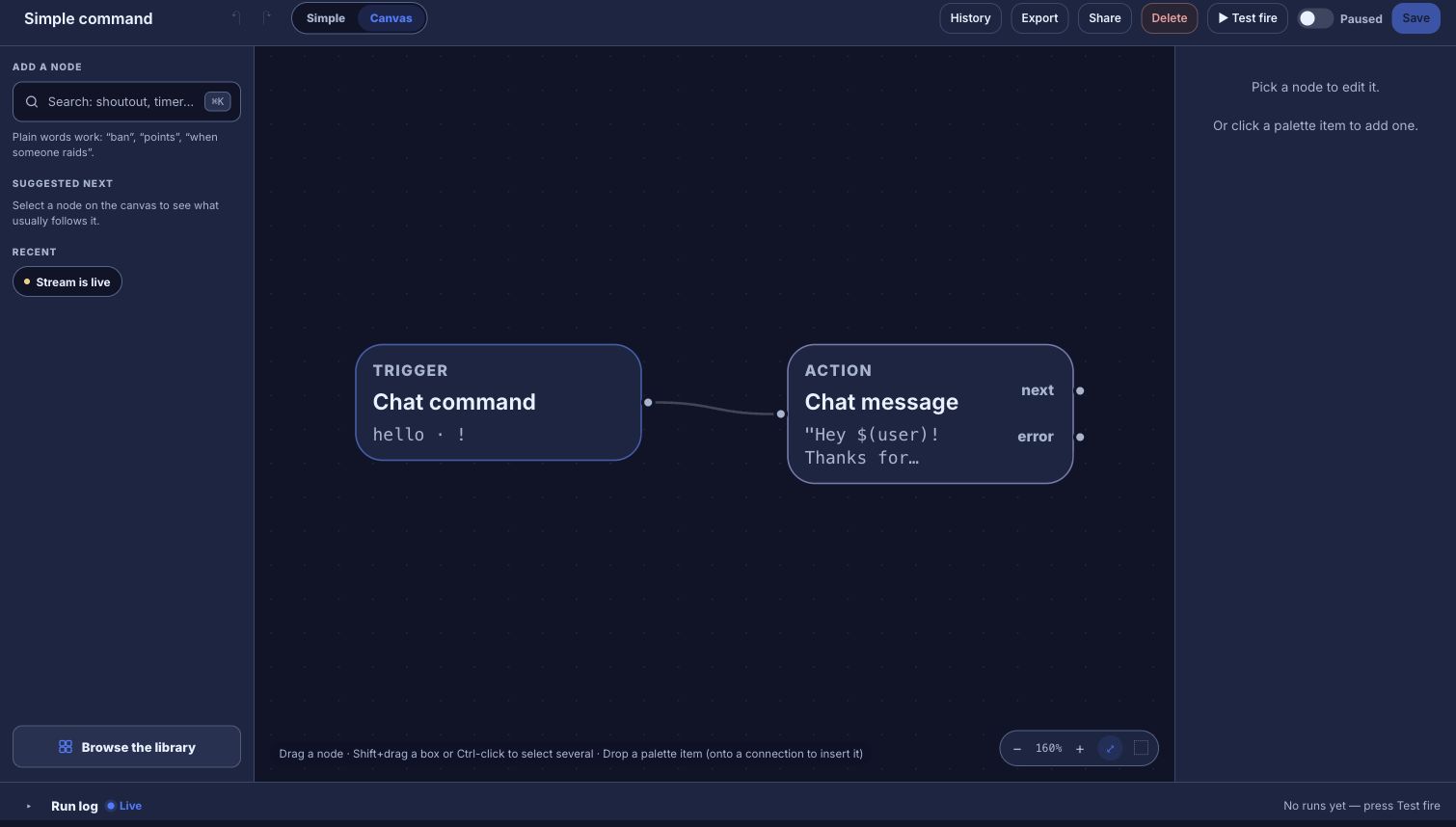
Open a flow and choose Canvas in the top bar. Lines show how execution moves between nodes. Click a node to edit its fields in the side panel. Use Fit to view to bring the whole graph back into view.
Find and connect a step
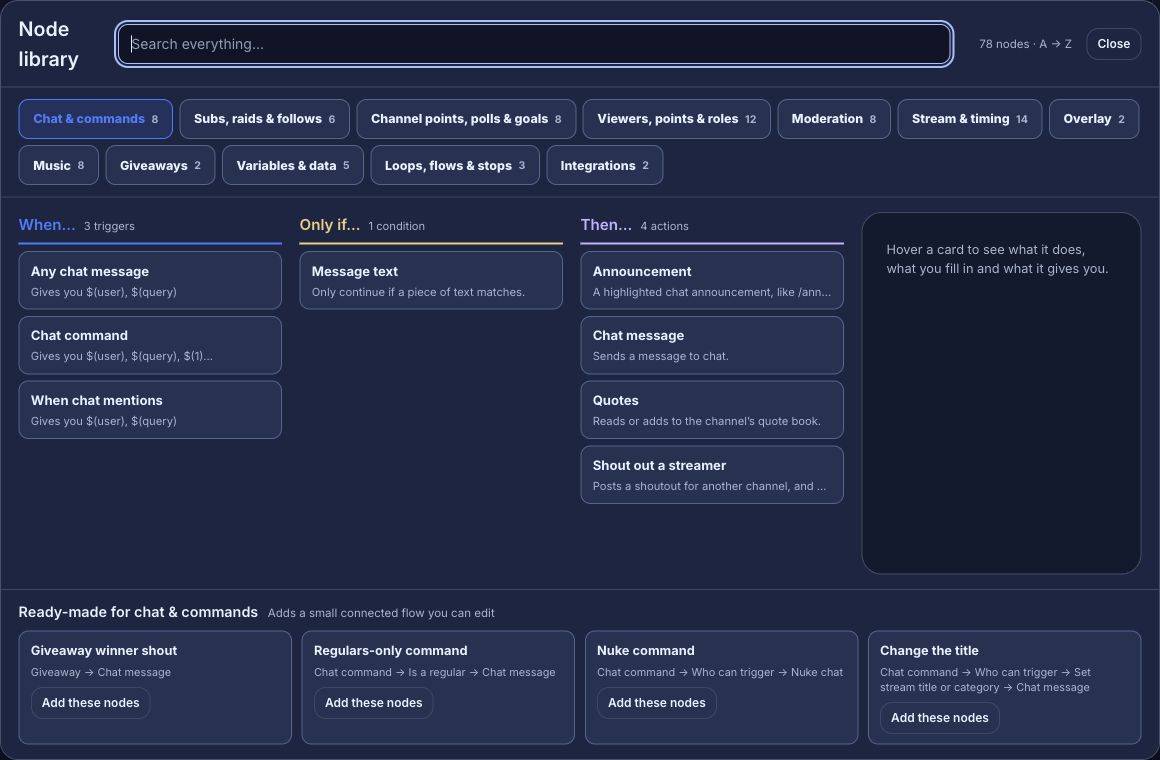
- Use the search button in Add a node, or open Browse the library. Search in plain words, such as “timer”, “points” or “shoutout”.
- Choose a node and fill in its fields. A node sitting on the canvas without a connection will not run.
- Connect the output of the previous step to the new node. You can also drop a palette item onto a connection to insert it.
- Read the output labels. A condition can take different paths; actions may have separate next and error outputs.
Check a value from the event
Most conditions check who is talking or how often something has run. Check a value from this event instead looks at a detail carried by whatever just triggered the flow — a Twitch prediction’s status, a goal’s current amount — using the same $(...) tokens the Insert… menu offers.
A Twitch prediction ends the same way whether it resolved or was cancelled, so a “prediction resolved” flow needs this condition to tell the two apart: check $(status) equals resolved before announcing a winner, or $(status) equals canceled before saying points were refunded. The Predictions pack ships both, already wired this way.
Test before enabling
Save your changes, then use Test fire. Expand the Run log to see which nodes ran, which checks stopped the path and which actions were simulated. A dry run helps check wiring; a real Twitch event is still needed to confirm the live connection and permissions.
A flow that starts on a Twitch event — a goal, a poll, a raid, a sub and the rest — test-fires with a realistic made-up example of that event, so conditions that check its details (such as whether a goal was reached, or which choice a poll picked) take a real path instead of failing on empty values. The result shows which example was used. When a trigger can fire at more than one moment — a poll starting, getting votes or ending; a goal in progress or reached — a small picker next to Test fire lets you choose which one to simulate.
Was this guide helpful?
Thanks. Your answer helps us decide which guides to improve.